featured stories
grey fox and the business of joy
grey fox and the business of joy
grey fox and the business of joy

by J. Ledesma (Photo: Volunteer "Dave" sharing his hat of honor)
After more than 30 years in the music business; teaching event production, managing artists, promoting shows, and attending hundreds of festivals as both a professional and a fan. I’ve learned that every great festival has its own identity. Some are defined by location, others by lineup, and a few by legacy.
In the bluegrass and Americana world, certain names come up again and again. Early on, when I began immersing myself in string band culture, several well-respected pickers from the Los Angeles scene told me the same thing: “Grey Fox belongs on your bucket list.” I heard stories of cross-country drives from California to Oak Hill, New York, all chasing what was described—without exaggeration—as one of the happiest musical experiences you could have.
This year, I finally made the trip.
I’ve been fortunate to spend time at iconic festivals like Father’s Day in Grass Valley in California and Telluride Music Festival in Colorado, events with breathtaking views, top-tier talent, and a kind of magic that’s hard to replicate. Grey Fox has all of that. But what sets it apart is something less tangible and far more powerful.
Joy.
From the moment I arrived at Walsh Farm, I felt it. Not in a vague or romantic sense, but in a real, consistent, human way that carried through every interaction across the weekend.
It starts with the volunteers, more than 500 of them. They are the heartbeat of Grey Fox. Every single person I encountered radiated a level of genuine happiness that felt almost surreal at first. But it didn’t take long to understand that it was completely authentic. Take the trash crew, for example. Driving around with an inflatable flamingo attached to their cart, proudly displaying signs like “Welcome to Trashachusetts” and “Dumpster Fulfillment,” they told me they had the best assignment at the festival. And they meant it. “Everyone has trash,” one of them said, “so we get to go everywhere, meet everyone, and help keep Walsh Farm beautiful.” You could see the pride in their work—and the joy in their faces.
That same energy carried over to the food areas, where volunteers and chefs treated one another, and festival-goers like real family. It wasn’t just about serving meals; it felt like being invited into someone’s home. “Did you get enough?” “Don’t forget to hydrate.” “Want me to make that to go?” These weren’t scripted interactions, they were genuine expressions of care.
Even the greeters and staff seemed fully committed to one simple idea: no matter who you are or why you came, you belong here.
At first, I found myself wondering how hundreds of people could show up with that level of enthusiasm, especially as volunteers. But after meeting the owners and production team, it all made sense. The culture of Grey Fox starts at the top. Volunteers are treated with deep respect, provided meals and perks, and recognized as essential to the experience, not just support staff, but stars in their own right.And that respect translates directly into the energy they give back.
Some of my most meaningful moments at Grey Fox came from simply talking with volunteers. I spent time with a cart driver who shared stories of his years at the festival, proudly showing off a hat covered in pins and badges, each one a memory. I had lunch with a volunteer who told me she came to support a friend with mobility challenges, encouraging her to attend despite her concerns. The next day, I met that friend backstage. She told me it was the best experience she’d ever had, and that she hoped to volunteer next year.
That’s the kind of impact you can’t manufacture.
The vendors brought that same spirit. Whether it was a jewelry maker, a coffee and sweets baker, or the pizza crew, everyone seemed genuinely happy to be there, trading recipes, dancing between orders, and connecting with people passing by as if they were renewing annual relationships.
Even the production side, often the most high-pressure environment at any festival, felt different. Audio engineers and front-of-house teams, who are usually under intense stress, carried themselves with calm, gratitude, and yes, joy. Not even rain or thunderstorms seemed to shake that.
And then there’s the music.
Grey Fox delivers an outstanding and diverse lineup, but what stood out to me was how artists interacted with the festival itself. Backstage, while spending time around acts like The SteelDrivers, Della Mae, Jason Carter, Michael Cleveland, and The Brothers Comatose, I noticed a common theme: artists talked about Grey Fox the way people talk about returning to a favorite place year after year. Like Disneyland for musicians.
They didn’t just perform, they participated and traded stories from previous years.
When they weren’t on stage, they were out in the crowd, watching sets, dancing, and connecting. I had a brief encounter with Ronnie McCoury, who lit up the Traveling McCourys Grateful Dead set under the dance tent. I could see his joyful expression while playing his electric four-string mandolin through pedals, something he doesn’t often get to play but enjoyed exploring that side of musical talent .
That sense of freedom extends to the performances themselves. Artists stretch out, experiment, collaborate, and create moments you won’t see anywhere else. During one particularly high-energy set, The Brothers Comatose pushed the crowd into such a frenzy that their fiddle player stage-dived, an unplanned moment that seemed to surprise him as much as the audience.
It was pure, unfiltered connection.
After decades in this business, I’ve learned to look beyond just production quality and talent when evaluating an event. What makes something truly special is how it makes people feel, and how consistently that feeling is shared across everyone involved.
At Grey Fox, that feeling is joy.
Not just on stage. Not just in the crowd. But everywhere, from the owners and organizers to the volunteers, vendors, crew, and artists. It’s built into the culture, reinforced through respect, and expressed in a thousand small human moments.
There are many great festivals out there. But I can honestly say I’ve never experienced one where joy was so present, so visible, and so universal.
At Grey Fox, no smiles are left behind.
Simply bronywn
grey fox and the business of joy
grey fox and the business of joy
by J. Ledesma
Bronwyn is one of the most important young figures in modern bluegrass, and her rise from elite sideman to solo artist has been unusually fast and convincing. The Charlottesville-born fiddler first earned a reputation through her work with Mile Twelve and later Molly Tuttle & Golden Highway, and she has already collected two IBMA Fiddle Player of the Year awards plus a Grammy win with Golden Highway.
Her most recent solo release is Rattlin’ Bones, which marks a clear step forward from her earlier solo records Fiddler’s Pastime and I Built a World. According to coverage around the album, it is a more songwriting-driven project, with Bronwyn writing most of the material herself and aiming for songs she can perform live with her own band. The album also reflects her growing identity as a front-person, not just a virtuoso instrumentalist, which is a big reason the record matters beyond fiddle circles.
On the chart side, Bronwyn has already proven commercial traction as well as artistic credibility. Her solo album I Built a World was a Grammy nominee, and industry coverage around the 2025 IBMA cycle also placed her among the album nominees for major bluegrass honors. That combination matters because it shows she is not just respected by fellow players, but also increasingly visible in the broader bluegrass marketplace.
The name change from Bronwyn Keith-Hynes to simply Bronwyn looks like a branding move as much as an artistic one. Reporting on the new album says she is entering a new phase and using only her first name going forward, while keeping the same commitment to bluegrass and the same musical identity. For an artist with growing national recognition, dropping the surname simplifies the brand, sharpens memorability, and creates a cleaner lane as she transitions from celebrated fiddler to full-fledged solo star.
Her marriage to fiddler Jason Carter also adds an interesting layer to her story, because it places her in one of bluegrass’s strongest fiddle dynasties without making her seem dependent on it. The two married at the Grand Ole Opry in October 2024, and reporting around their relationship highlights both mutual admiration and a shared musical life, with the couple settling into married life in Tennessee while balancing active touring and recording careers. That partnership feels especially resonant in bluegrass, where authenticity, musicianship, and personal story all matter deeply.
What makes Bronwyn such a force in today’s bluegrass market is that she checks every box at once: elite instrumental skill, real vocal presence, strong songwriting growth, award credibility, and a compelling personal narrative. She appeals to traditional bluegrass fans because her fiddle chops are undeniable, but she also reaches newer audiences because her recent work feels contemporary, intentional, and emotionally accessible. In a crowded roots-music field, she stands out as one of the rare artists who can anchor a festival bill, lead her own band, and still command respect as one of the genre’s top instrumentalists.
About the Record:
Bronwyn’s Rattlin’ Bones leans into themes of travel, individuality, adventure, love, and a darker classic-bluegrass edge that includes references to murder and hard-lived experience. The album was shaped by her years on the road, her home base in Nashville, and the sense that life had settled just enough to let her stir up new creative chaos.
The lead song, “Sticks and Stones,” frames the record’s emotional center with a lyric that feels defiant, reflective, and a little haunted: “sticks and stones, rattlin’ bones, I don’t need no heartache”. That title track seems to capture the album’s broader mood well — a mix of grit, motion, and emotional self-protection — while still leaving room for the live-band energy Bronwyn wanted to bring to the project.
A useful way to think about the record is that it balances rootedness and restless motion. On one hand, the songs come from real life, marriage, and a more settled personal chapter; on the other, they still push outward into road stories, imagined scenes, and the kind of swagger associated with classic bluegrass and outlaw-country influence. That combination gives the album a personality that feels both personal and performance-ready.
Summer Festival season is thriving on the west coast
Good Old Fashioned Aug 6-9, 2026
pickin in the pines Sept 18-20, 2026
Good Old Fashioned Aug 6-9, 2026

The 2026 Good Old Fashioned Bluegrass Festival is presented by the Northern California Bluegrass Society and runs August 6–9, 2026. It takes place at San Benito County Historical Park in Tres Pinos, just south of Hollister, and it’s set up as a family-friendly, camping-heavy bluegrass weekend with a strong emphasis on jamming, kids’ activities, and an old-school festival feel.
From an artist-fan perspective, the event is still building out its full 2026 band list, but the festival’s own site says it is actively processing band applications and already has a main-stage schedule underway. One listed appearance tied to the weekend is Honey Buckets on Friday, August 7 at 8:00 p.m.. That suggests the lineup is a mix of regional and touring bluegrass acts, with the broader schedule likely being finalized close to the event.
On affordability, this looks like one of the more accessible multi-day bluegrass festivals in California. Camping is included with all multi-day tickets, tickets can be bought at the gate, and there are no required reservations, which lowers planning friction for attendees. The festival is free for children 12 and under, and kids 13–17 can attend free with pre-festival Kids Camp registration, making it especially attractive for families.
There are also practical cost advantages that matter for potential attendees. Thursday pre-festival camping is listed at $15 per adult, RV hookups are not generally available, and there is a designated dog camping area, which helps keep the event relaxed and budget-conscious compared with larger ticketed festivals. In short, GOF 2026 looks like a grassroots, family-forward bluegrass gathering with reasonable access, low-friction camping, and a setting that rewards people who value community, picking, and a laid-back festival experience.
summergrass Aug 14-16, 2026
pickin in the pines Sept 18-20, 2026
Good Old Fashioned Aug 6-9, 2026
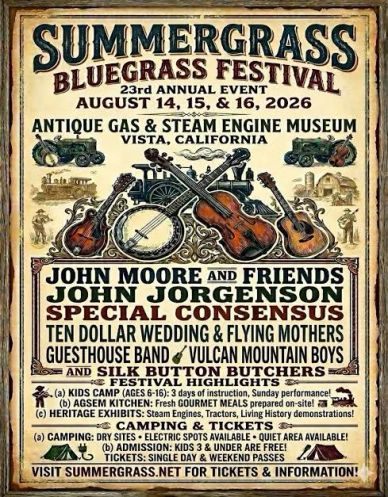
It’s the 23rd annual festival, hosted by the Antique Gas & Steam Engine Museum in Vista, California, and it runs August 14–16, 2026.
The 2026 lineup announced so far includes John Moore and Friends, John Jorgenson, Special Consensus, and the Po’ Ramblin Boys, with support acts including The Guesthouse Band, Ten Dollar Wedding, and The Flying Mothers. That’s a well-balanced bill: John Jorgenson brings crossover appeal, Special Consensus is a trusted traditional anchor, and the Po’ Ramblin Boys give it a newer touring edge that should play well with both hardcore pickers and casual fans.
In terms of location, Summergrass is set on the museum grounds at 2040 N Santa Fe Avenue in Vista, which gives it a distinctive, laid-back festival atmosphere rather than a big-box fairground feel. The camping setup is a major part of the experience: the festival offers onsite dry camping, with five nights included in the camping purchase, and campers can choose Main, West, or Quiet campground areas. That makes it attractive for attendees who want the full immersion weekend without the complexity of a larger, more expensive event.
Affordability is one of Summergrass’s selling points. A posted 3-day pass was listed at $110, and campground options were shown at very low add-on prices: $20 total for dry RV camping and $10 total for tent camping. The festival also notes that camping can be purchased in advance or at the gate, and that advance purchase helps secure a preferred spot, which is useful for budget-minded fans trying to plan around travel and lodging costs.
For potential attendees, Summergrass feels like a good-value weekend because it combines a respected lineup, a single venue with camping, and a manageable ticket structure. If someone is looking for a bluegrass getaway that is easier on the wallet than many multi-day festivals, this one makes a convincing case.
pickin in the pines Sept 18-20, 2026
pickin in the pines Sept 18-20, 2026
pickin in the pines Sept 18-20, 2026
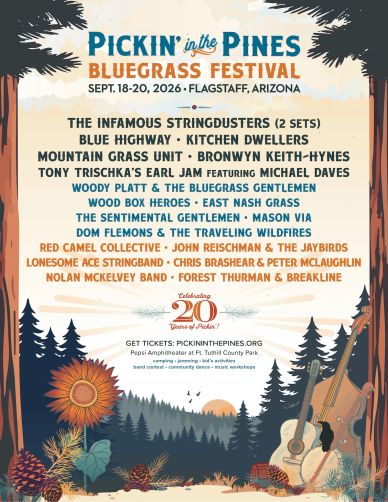
Pickin’ in the Pines 2026 is a solid Arizona bluegrass weekend to spotlight because it pairs a mountain setting with a very usable ticket structure. It’s the festival’s 20th anniversary, held September 18–20, 2026 at Pepsi Amphitheater in Fort Tuthill County Park in Flagstaff, with camping at the nearby county campground.
The 2026 lineup includes The Infamous Stringdusters and Blue Highway, and the festival’s own lineup page says the bill also includes Kitchen Dwellers, The Del McCoury Band, and other acts still being promoted through the official lineup posts. That gives it a nice range: headline-level national names, strong traditional anchors, and the kind of jam-friendly energy that usually plays well with both dedicated bluegrass fans and broader acoustic audiences.
For affordability, Pickin’ in the Pines is fairly transparent and easy to plan around. The official ticket page lists a 3-day festival pass at $204, with single-day tickets at $102 for Friday, $102 for Saturday, and $90 for Sunday; there is also a limited Sunday resident option for Coconino County at $78. Camping is separate from the non-camping festival pass, but the event does offer a family-oriented structure, including kids’ pricing at $30 for the weekend or $10 per day for ages 4–14, with kids 3 and under free.
That pricing makes the festival feel mid-range rather than bargain-basement, but still accessible for a destination bluegrass event in a scenic market like Flagstaff. The combination of single-day tickets, family pricing, and a centralized venue/camping setup makes it especially appealing for fans who want to sample one day or two without committing to a full high-cost festival trip.